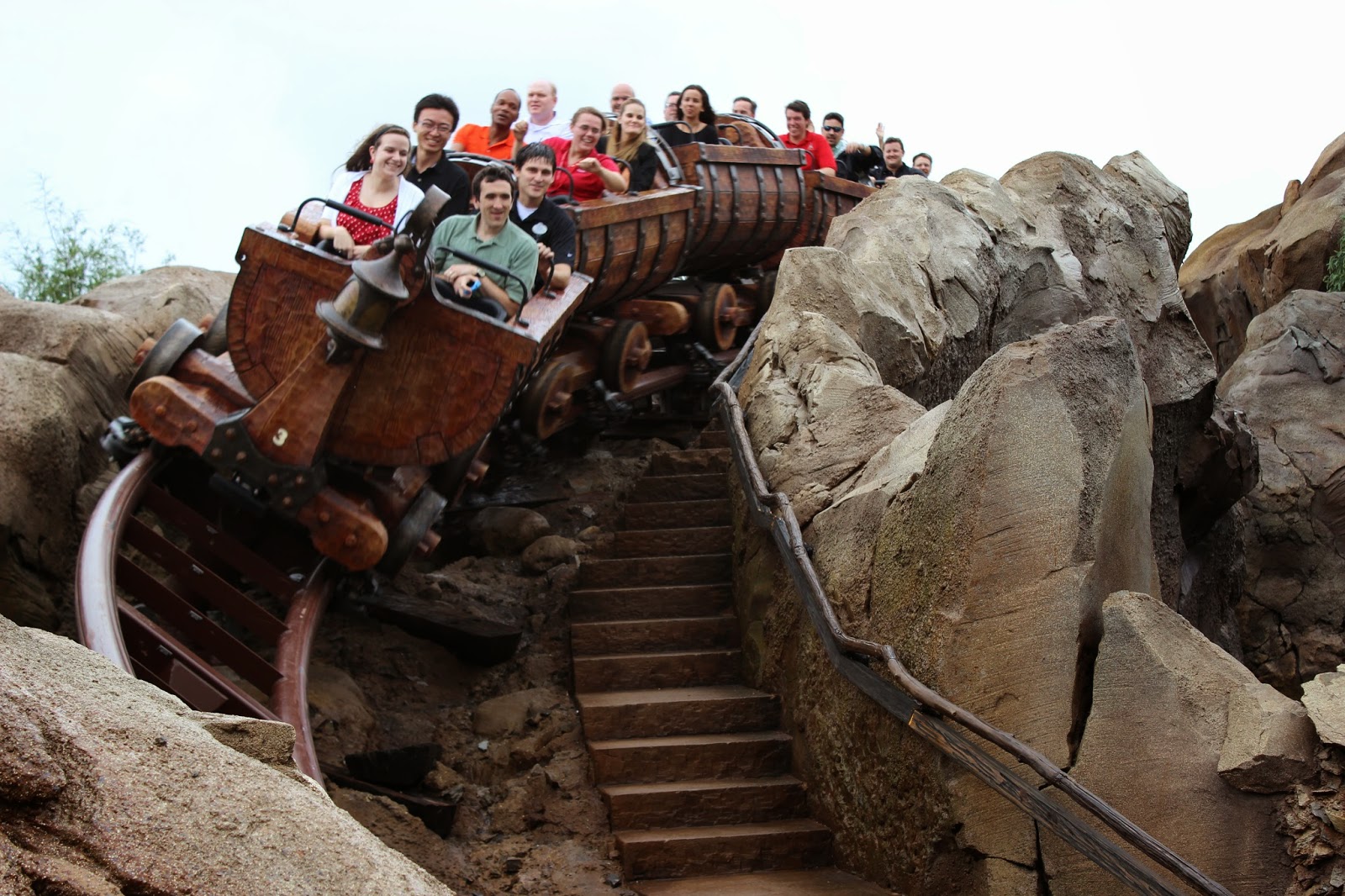
In this series, we'll be looking at details that are hidden all around you at the parks. The Imagineers do a great job placing in many hidden gems and things to try that one has to take a moment to notice, or explore. Many of these are obvious and in plain sight, and some are hidden quite well, you just have to know where to look.
*A note; in this article, I use words such as 'most likely'; this is because the mechanisms I'm talking about are proprietary knowledge, and since I don't have these, I'm just giving an educated guess as to how it's performed.
One of the best ways to help tell a story is to provide effects that help promote the reality of the situation and enhance the story vehicle; sometimes, quite literally.
One of the most detailed and very well presented stories, yet usually one of the most ignored by average park-goers, is that of the Royal Anandapur Railway out of the village of Serka Zong. For most folks, I speak of Expedition Everest.
This ride is full of so many touches and details, I could write of them for some time. The average rider tends to ignore them, and walk straight through the many wonderful rooms of the queue, or figure out the best way to ride quickly. However, I'll just be focusing on a little detail of train itself, that helps convince you that you really are traveling on an old, rack-and-pinion steam engine.
How would you know you were riding a steam engine? What would tip you off? Most likely: it would be steaming. There are certainly other characteristics, but the outpouring of steam is usually a good clue. While this little engine isn't what most folks expect as an engine, it's actually modeled around pushing engines, found around the world. They are found on railways where it's beneficial to have an engine behind cars, rather than the usual pulling; usually, this is important in railways up steep inclines, such as mountainsides.
As the train rounds the corner to stop at the station, the engine at the back is heard to release a valve, and then a cloud of steam; it's releasing excess steam that wasn't previously used, so as to release pressure. Of course, we know that it's not powered by steam, so how is this done?
?
If you take a look, under where the engine would sit as it stops, there is a small vent, which is fed, most likely, by a boiler, off scene from the guests.
Here is a closer look, with a very handy warning label, identifying its contents. As the train enters the station, it trips sensors that help the station identify where it is in the station. This is also how the train performs its stop and loading/unloading procedures. Once it stops, the station is notified, and a valve is released. This allows a measured amount of steam to escape through the vent, where its likely funneled through various orifices and vents to simulate the boiler and engine letting off steam as it stops.
Voila!
Besides that, there is the occasional sound effects along the ride route that the train and environment give off, but that's about it. One thing that would complete the effect would have to be at least continual chugging; who doesn't think that synonymous with a steam engine?
Missed It's in the Details #16? Check it out here!